
5 Mistakes Selling Digital Products (And What I'd Do Instead)
Sep 22, 2026The most common mistakes sellers make with digital products are creating a product before checking that anyone wants it, using weak listing images, waiting too long to start an email list, never testing paid ads, and trying to grow alone. Most of these are sequence problems rather than skill problems — the work still gets done, just too late to help. Fixing them means moving research, list building, and outreach earlier than feels comfortable.
Heads up — some links below are affiliate links, which means I may earn a small commission if you buy through them, at no extra cost to you. I only recommend tools I actually use.
Key takeaways
- Research demand before you pick a product type — not after you've built twenty listings.
- Your listing images do most of the selling. Budget real money and real time for mockups.
- Start your email list before you feel ready.
- A few dollars a day in ads buys you data, not just sales.
- Collaborating lets you borrow trust someone else already spent years building.
I've been selling digital products for about ten years.
Which means I've had ten years to make pretty much every mistake on the menu.
And real talk — I'm not mad about it. Most of what I know came from getting it wrong first. But if I could hand my past self one list before she opened that first shop? This would be it.
Five things. Zero fluff.
How do you know if a digital product will actually sell?
You check demand before you create anything. That means looking at what's already selling in your category, confirming people are searching for it, and then building your version of that — instead of building first and hoping.
Mistake #1: I made things I personally loved and assumed everyone else would love them too.
I mean… I loved them. Why wouldn't everybody?
Whyyyyy did I think that. I skipped the research phase almost entirely and put weeks into products nobody was looking for.
And I'm not the only one. Among the 147 sellers in the 2026 Digital Product Sellers Survey who answered the question about advice that failed them, 6% volunteered some version of "build it and they'll come" or "just upload and people will buy" — unprompted, as the thing that didn't work.
Here's how I'd do it now. Research happens in two phases.
Phase one: pick your product type
This is the broad category. Printables, templates, planners, wall art, worksheets.
I start free, on Etsy itself. Etsy is where a huge chunk of digital product buyers actually shop, so it's also where I do my looking.
Type your idea into the search bar and read the first two pages of results. Etsy's algorithm rewards listings that sell well and sell consistently by ranking them up top — so if something's on page one and it doesn't say ad or sponsored, it's ranking organically. Which means it's working.
Never copy anyone element for element. But looking at what buyers are already choosing? That's just doing your homework.
After the free pass, I go to Sale Samurai for the actual numbers.
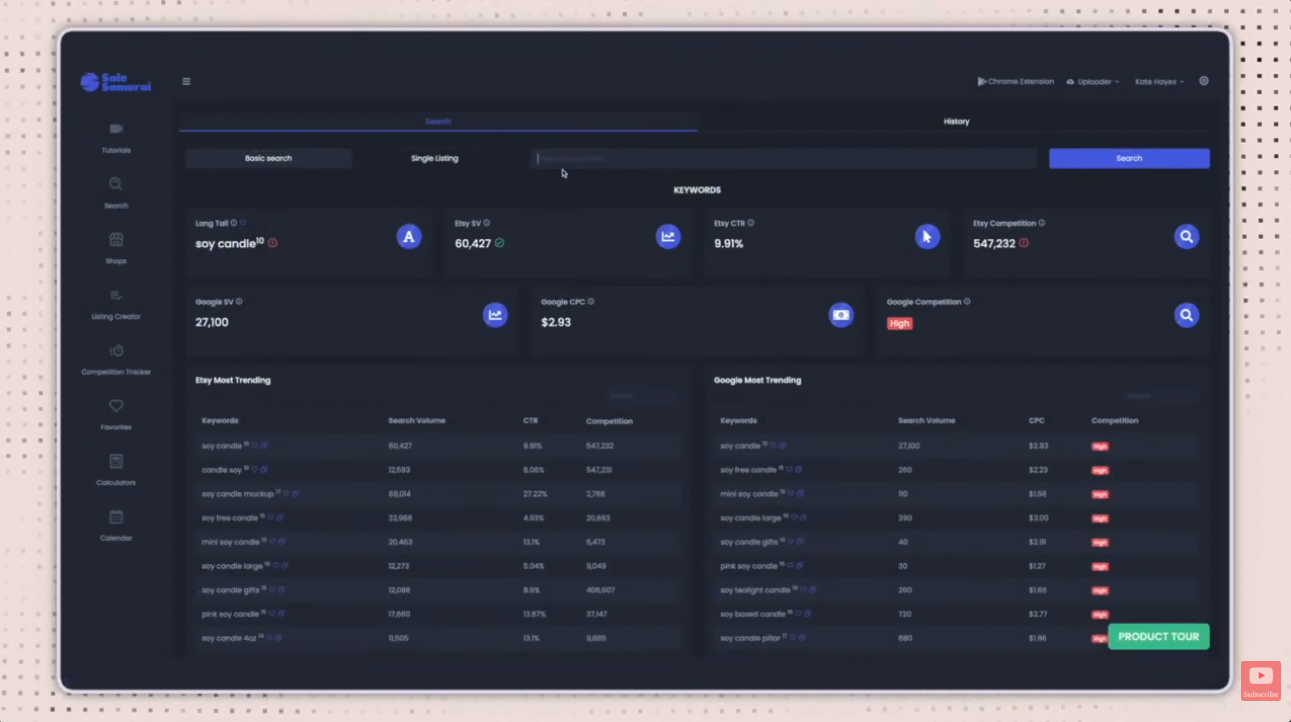
Real example. I typed in soy candle — over 60,000 searches a month on Etsy. Promising. But the competition score came back high, meaning a ton of sellers are chasing that exact keyword.
So I niched down. Funny soy candle — still over 17,000 searches a month, with far lower competition. Same demand, way less fighting.
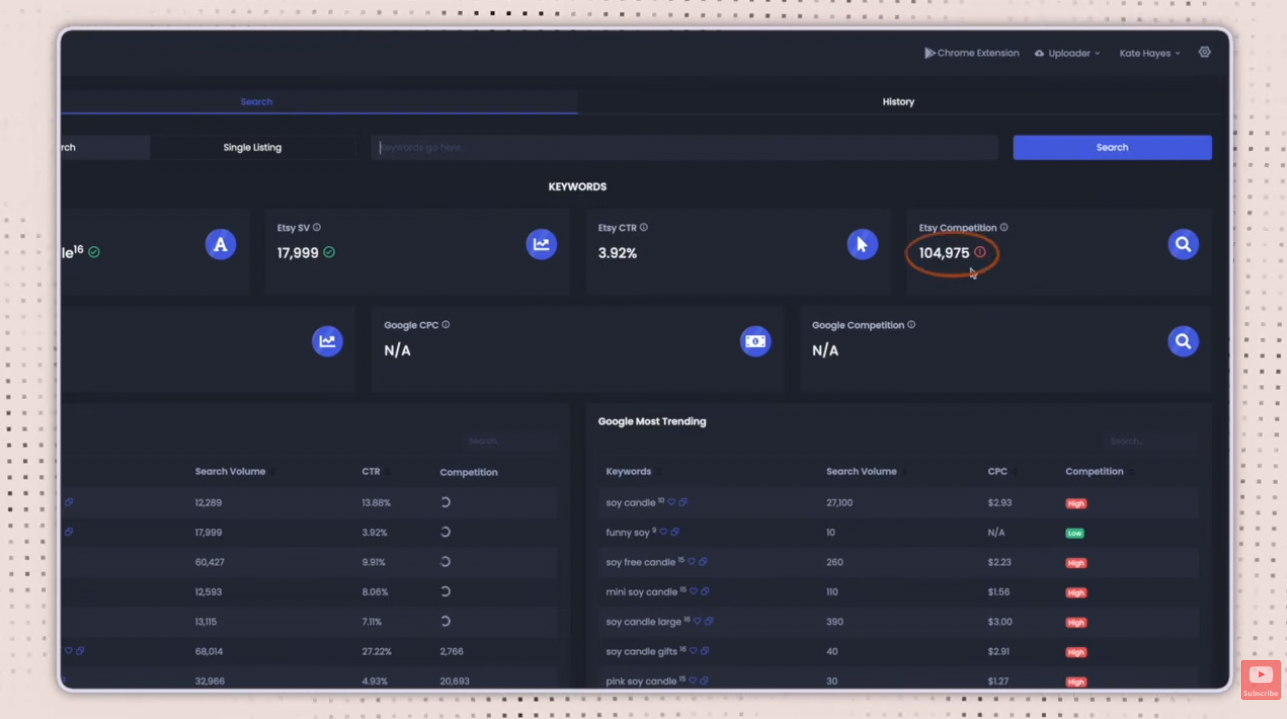
Then I scrolled to the related keywords and found mini soy candle sitting at over 20,000 searches a month, which I never would have thought of on my own.
That's the whole game. Find where real demand overlaps with a gap you can actually squeeze into.
And no, you don't need a hundred of them before anything happens — I went through how many digital products you actually need to make your first sale in a separate post, and the number is much smaller than people assume.
Phase two: pick your style
Once you know what you're making, figure out how it should look.
Every year Canva and Creative Market publish design trend reports. I read them, pick two or three trends that fit what I'm building, and ignore the rest.
You're not reinventing anything. You're taking something that already sells, changing one or two elements, and giving it a reason to be yours.
Watch the full breakdown on YouTube →
Do listing images actually matter for digital products?
They matter more than almost anything else on the listing. A buyer can't hold a digital product, so your images are the only way they can judge what they're getting — which makes them the main thing that converts a click into a sale.
Mistake #2: I treated my listing images as the last step instead of the main event.
If you sell something physical, you photograph it. We don't get that. What we get are mockups.
A mockup is an image that shows a buyer what your product looks like out in the real world. Your wall art, framed and hanging. Your planner, printed and on a desk.
Selling something that isn't meant to be printed, like a template? You still need them. Screenshot the pages included in your product and arrange them so they look intentional — or show them on a laptop, a phone, a tablet.
Mockups are a non-negotiable. Decide on day one that you're investing in them, and I mean both kinds of investing.
Money: buy a good mockup bundle. Etsy and Creative Market are both full of them.
Time: actually sit down and build the images properly. Drop your product pages in, line them up, make them look like something a real business made.
And do the same research you did on product type. Pull up the top-ranking listings in your niche and study their images. What's the first one? How many do they use? What's the vibe? That tells you what buyers in your corner respond to.
Your images are how you communicate value. Do not skimp here, friend.
Feeling lost on the technical side of all this — file types, resolution, what software to even use? I made a free Digital Products Starter Guide that walks you through the whole foundation.
When should you start an email list for digital products?
Before your first product goes live, if you can. An email list takes time to grow and converts better than any social platform, so the earlier it starts, the sooner it's useful. There is no audience size too small to begin.
Mistake #3: I waited years.
Years. And within about a month of finally starting, I understood exactly what I'd been missing.
Social media is great for getting found. Cold people discover you, they poke around, some of them stick. But it can't be the whole plan, because you don't own any of it.
Your email list is the one audience nobody can take from you or throttle on a Tuesday.
This tracks with what sellers told us, too. In that same survey, the single most-named piece of failed advice among the 147 who answered was "just post on social media and the sales will come" — 9% of them brought it up on their own.
If social is currently carrying all the weight in your business, it's worth reading how to market digital products next — email is one of four strategies I break down there.
Here's the short version of getting started.
Step 1 — Create a lead magnet
A freebie. Something worth handing over an email address for, because nobody subscribes for fun anymore.
Make it digital so it delivers instantly, and make it connect to what you sell. A checklist, a small set of printables, a mini guide. If you're stuck, I have a list of 38 lead magnet ideas you can steal from.
Step 2 — Build a landing page
Not a website. One page, one job: name, email, subscribe.
A mockup of the freebie, a headline, a couple lines explaining what they get, and the form. That's it. You build this inside your email provider — Kit is my pick for beginners because their landing page templates mean you're not starting from a blank screen. It's free to start.
Step 3 — Write a welcome sequence
Three to five emails that go out automatically over someone's first week or so.
Email one delivers the freebie immediately. The rest introduce you, help them, and build enough trust that when you do ask for a sale, it doesn't feel like it came out of nowhere.
Then here's the pro tip nobody does enough: talk about your freebie constantly. Every platform. Every conversation. Ask other people to share it. You cannot over-mention your lead magnet — the ceiling is way higher than you think it is.
Are paid ads worth it when you're just starting out?
Yes, in small amounts, and mainly as research rather than as a sales engine. Even a couple of dollars a day shows you which listings people click and which ones they ignore, which is information organic traffic takes months to give you.
Mistake #4: I avoided ads for way too long because they felt like a big-business thing.
Almost everything I teach on my channel is organic and free. That's genuinely my preference. But I'd still try ads sooner if I were starting again.
Not to get rich off them. To get data.
You can run ads in a lot of places — Etsy ads, Meta ads on Facebook and Instagram, Pinterest, Google. If you're on Etsy and your budget is small, start with Etsy ads. Same platform, same buyers, easiest to read.
Start at a couple dollars a day. Truly. You are not trying to scale anything yet, you're trying to find out which of your products has legs.
Then double down. Whatever's getting clicks and favorites and sales, put your spend there and let the rest sit.
Still not sure what you'd even sell? Grab my master list of 100+ digital product ideas and go browse.
Should you collaborate with other digital product sellers?
Yes, and earlier than feels comfortable. Collaborating puts you in front of an audience someone else already built and already earned trust with, which is the part you cannot shortcut on your own.
Mistake #5: I was a lone ranger for years.
Honestly? It was imposter syndrome. I felt weird reaching out to anyone. Who am I to ask this person to partner with me?
I see you, because I was you.
Once I got over it, everything moved faster. Not because collaborating is magic, but because I stopped building from zero every single time. When someone recommends you to their people, you inherit the trust they spent years earning.
That's the actual asset. Not the follower count — the trust.
Who to reach out to:
- Other business owners in a related niche — not direct competitors. Someone whose product sits next to yours instead of against it.
- Influencers in your space, including small ones. Especially small ones.
And when you pitch, lead with what's in it for them. A coupon code for their audience. Free product. A shout-out to your people. Make the answer to "why would I do this" obvious in the first two sentences.
Both sides get something. That's the whole point.
What would you actually do first if you were starting over?
In order: research demand before choosing a product type, build two or three products, create quality mockups for them, set up a freebie and a landing page, and only then spend money on ads. Collaboration outreach can start at any point, including before your first product is finished.
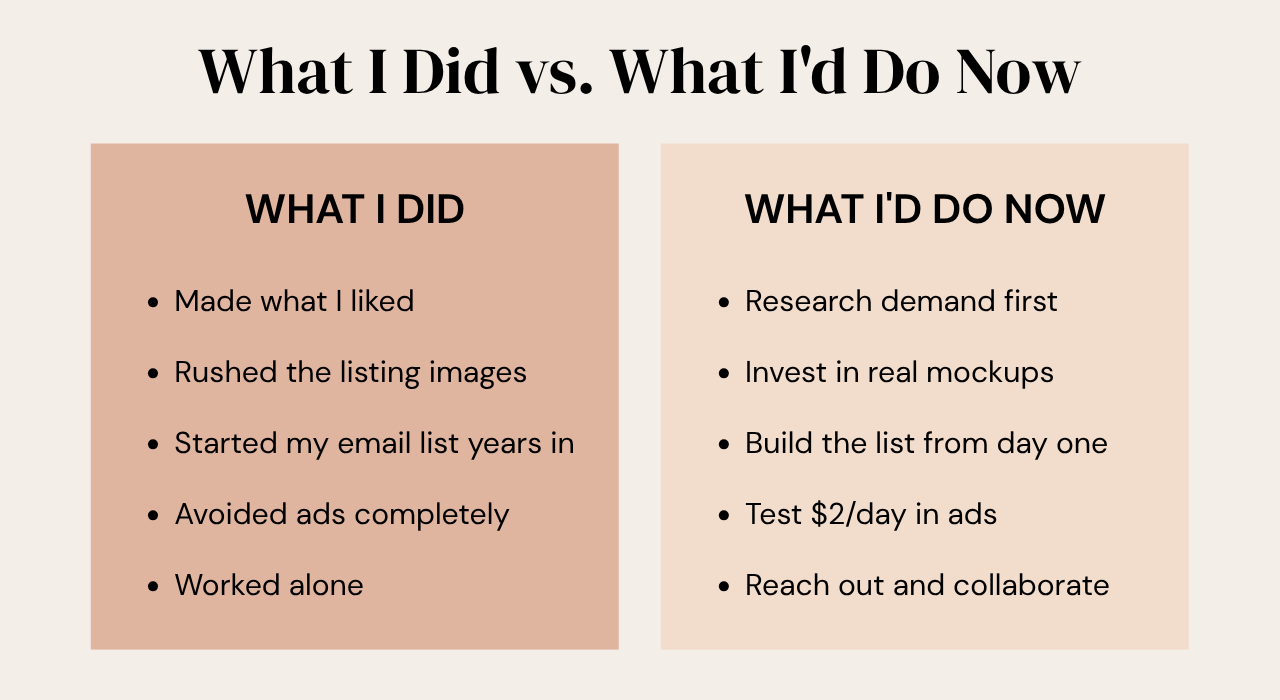
The reason the order matters is that four of these five mistakes are timing mistakes. I eventually did all of it. I just did most of it late, which is a much more expensive way to learn.
Frequently asked questions
How much research should I do before creating a digital product?
Enough to confirm two things: that people are searching for it, and that similar products are already selling. In practice that's usually a few hours — a pass through the first two pages of Etsy results for your idea, then a keyword check on three or four phrasings of it. You're looking for proof of demand, not certainty.
Do I need a paid keyword tool to sell digital products?
No. Searching on the platform itself is free and tells you a lot, since well-ranked organic listings are already evidence of what sells. A paid tool like Sale Samurai speeds things up by giving you actual search volume and competition numbers instead of estimates, which matters most when you're deciding between several ideas.
What exactly is a mockup?
A mockup is an image showing your digital product as it would appear in real life — printed and framed, opened on a laptop, sitting on a desk. You buy mockup templates as bundles and drop your own designs into them. They exist because a buyer can't physically hold a digital file, so the mockup does that job instead.
How many emails should a welcome sequence have?
Three to five, sent automatically over roughly the first week. The first one delivers the freebie immediately. The rest introduce who you are, give something genuinely useful, and warm people up before any sales ask.
How much should I spend on ads when I'm starting out?
A couple of dollars a day is enough at the beginning. The goal at that budget isn't profit — it's finding out which products people click on. Once one listing clearly outperforms the others, move your spend onto it instead of spreading it evenly.
How do I find people to collaborate with when my audience is tiny?
Look for sellers whose products complement yours rather than compete, and don't skip people with small audiences — they're far more likely to say yes and their audiences tend to be more engaged. Lead the pitch with what they get: a discount code for their people, free access to your product, or a shout-out to yours.
Which of these five fixes should I do first?
Research, because everything downstream depends on it. There's no point perfecting mockups or running ads for a product nobody was looking for. If research is already done, the email list is the next highest-leverage thing, since it takes the longest to compound.
Want the whole thing laid out properly?
I made a free 45-minute masterclass that walks through the full system for building a digital product business — the research, the products, the marketing, all of it in order. It's on demand, so you can watch it whenever.
So — which of these five are you guilty of right now? Hit reply on my next email and tell me. I read every one.
Not on my list yet? Grab the free Digital Products Starter Guide and you'll be automatically added!
