

How Many Digital Products Do You Need to Make Your First Sale?
Aug 17, 2026Most digital product sellers make their first sale with a small catalog, not a large one. Among the 93 sellers in the 2026 What Actually Works for Digital Product Sellers survey who had made a sale, 57% got their first one with 10 or fewer products listed, and 30% got there with 5 or fewer. There is no minimum number of products required to make a sale. What determines whether a product sells is how specific it is, how clearly it names an outcome for a particular buyer, and whether anyone is being sent to look at it.
Key takeaways
- 57% of sellers in our survey made their first sale with 10 or fewer products listed (53 of the 93 sellers who had made a sale).
- 30% made that first sale with five or fewer products live.
- Smaller catalogs sold faster — 53% of sellers with 10 or fewer products sold within a month, versus 25% of sellers with 11 or more.
- "You need 100+ listings" was named as advice that did not work by 9 of the 147 sellers who answered that question — unprompted.
- More products is not a traffic strategy. Specific products plus a way to be found is.
Real talk: the "100 listings" rule has cost more beginners more weekends than just about any other advice in this space.
I hear some version of this constantly. I have 87 products up and nothing is selling — should I add more?
Nah, friend. Adding more is not the fix. And I've got the numbers to show you why.
How many digital products do you need to make your first sale?
You need one product that solves a specific problem for a specific person, and a way for that person to find it. That's the honest answer, and the survey data backs it up.
Here's the breakdown from the 93 sellers in our survey who had actually made a sale:
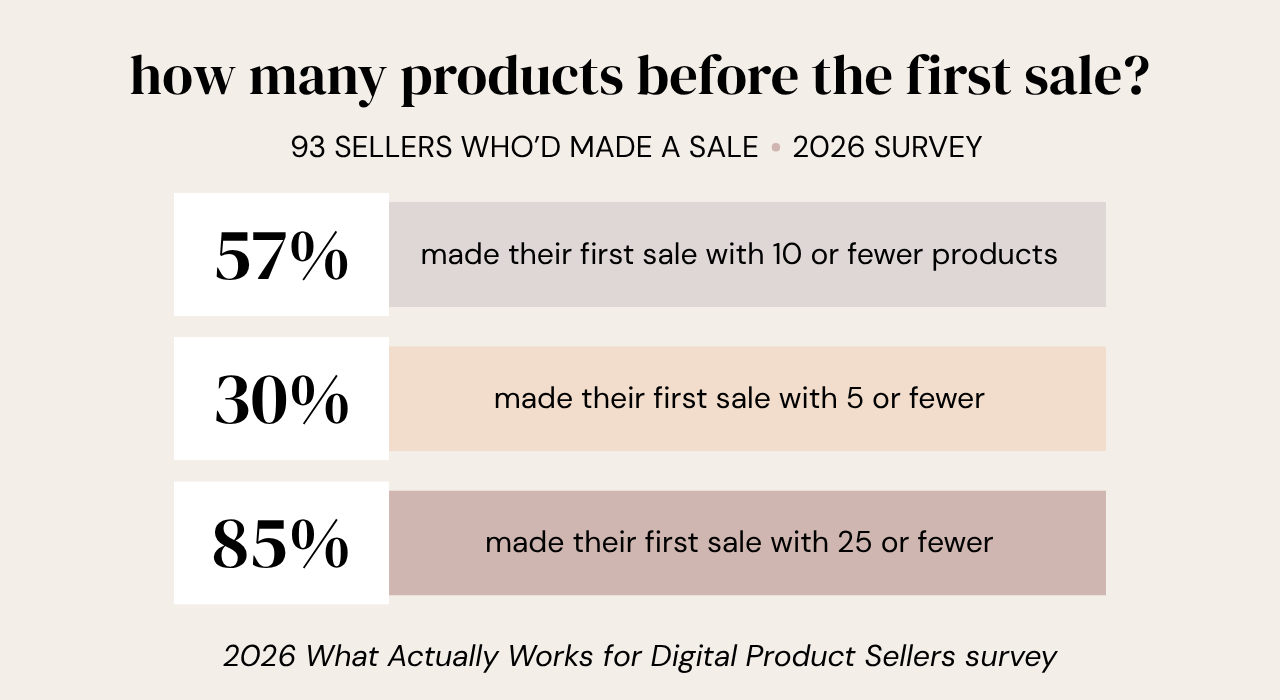
- 57% made their first sale with 10 or fewer products listed
- 30% made it with five or fewer
- 85% made it with 25 or fewer
- Only 15% needed more than 25 products
- Just 5% needed more than 50
But here's the part that actually surprised me.
The sellers with smaller shops didn't just sell — they sold faster. Among sellers in our survey with 10 or fewer products, 53% made their first sale within a month. For sellers with 11 or more products, that number dropped to 25%.
Twice as fast, with a fraction of the work.
I checked whether that was just newer sellers answering differently, because that's the obvious objection. It isn't. Small-catalog and large-catalog sellers were spread evenly across how long they'd been in business, so the gap holds.
Spoiler alert: nobody is out here buying your 43rd product because it was your 43rd.
Watch the full breakdown on YouTube →
Why doesn't adding more products get you more sales?
Because the thing that used to make volume work — being one of relatively few sellers in a category — isn't true anymore. The barrier to entry has dropped to almost nothing, marketplaces are more crowded than they've ever been, and a lot of what beginners are uploading is exactly what an AI tool can now generate for free in about eight seconds.
A hundred generic products don't add up to one good one. They add up to a shop that looks like it's guessing.
One seller in our survey put it better than I could:
"The idea of having 100+ random printables up in my shop for it to work. This didn't help, now it just looks like a garage sale."
That's the whole problem in one sentence.
When your shop has a party invitation, a budget tracker, a workout log, and a set of wedding signs, a shopper can't tell what you do. Neither can the algorithm. And neither of them sticks around to figure it out.
How many Etsy listings do you need to make sales?
Etsy requires exactly one active listing to open a shop, and there is no listing threshold that triggers sales. The commonly repeated numbers — 100 listings, 50 listings, "fill the first page" — are not Etsy policy and never have been.
Here's the nuance, because there is one.
On Etsy, more listings genuinely can mean more surface area in search, since each listing targets its own set of keywords. That part is real. But it only counts if each listing targets a different phrase a real shopper actually types.
Twenty listings chasing the same three keywords isn't twenty chances. It's one chance, twenty times, competing with yourself.
That's why the sellers in our survey with small, focused catalogs outperformed the ones with sprawling shops. Not because small is magic — because focused listings do a job, and filler listings just sit there costing twenty cents a pop.
Not sure what to make first? My free Digital Product Starter Guide walks through what to create, where to sell it, and the techy stuff nobody explains — file types, sizing, resolution — in plain English. It's the shortcut I wish I'd had.
What should you do instead of adding more products?
Five things, in order. This is the part that actually moves the needle.
1. Pick a higher-value, niche-specific product type
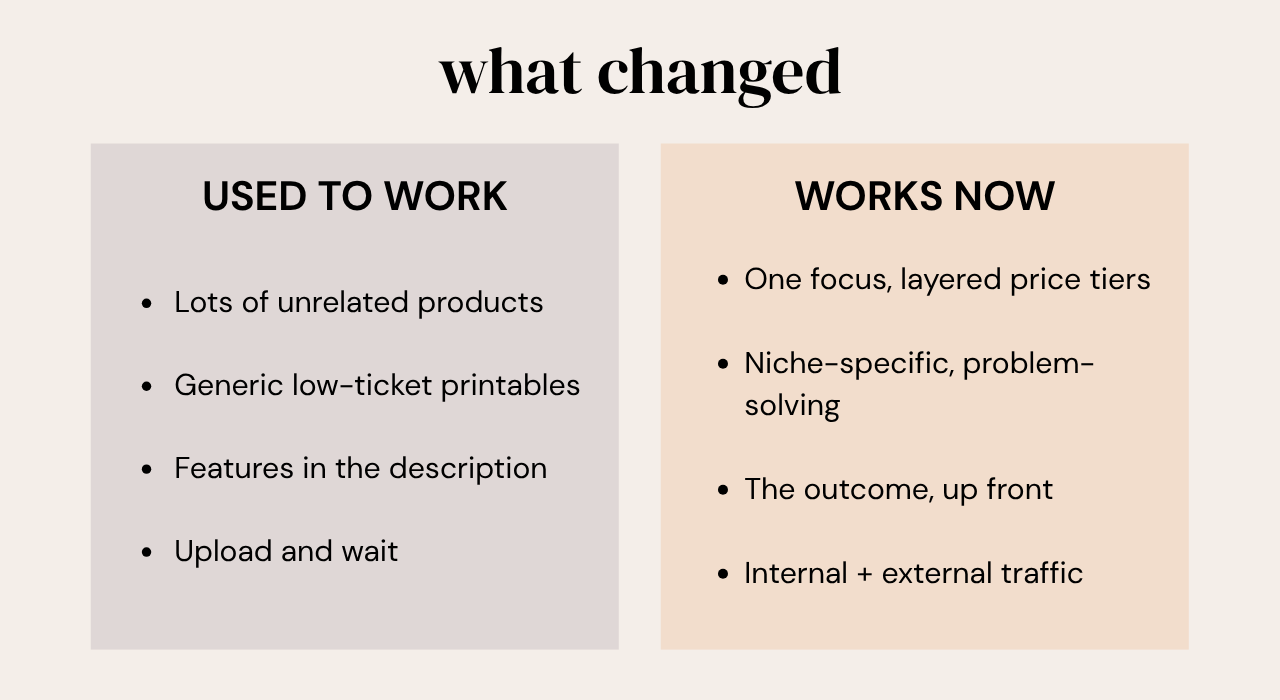
Generic used to be fine. A basic planner, a broad printable calendar, a template that could work for anybody — those sold, cheaply, in volume.
Now the products that sell are specific to a niche or solve a real problem for a defined person. Instead of a $3 printable calendar that fits nobody in particular, sell a fitness bundle built entirely around fitness. Or real estate. Or homeschooling. Or dog training.
The niche isn't the point. The specificity is.
2. Communicate the outcome, not the features
Nobody wakes up wanting an online course with 50 lessons at 10 minutes each. They want to lose 20 pounds, or get their dog to stop jumping on guests, or make their first hundred sales.
Your conversion rate lives or dies on how clearly you name the result.
Three questions to pin yours down:
- What's the transformation — where does your customer start, and where do they end up?
- What will they be able to do after using this that they couldn't do before?
- What measurable result do they get?
So instead of "Canva social media template bundle," you're selling "30 Instagram post templates for personal trainers to book their first 10 clients."
Same product. Completely different listing.
3. Use internal and external traffic — not one or the other
Your products can't sell if nobody sees them, and traffic comes from two places.
Internal traffic comes from building where an audience already exists. Etsy and Creative Market have people actively searching for what you make. That's also where SEO lives — using the phrases real shoppers type in your titles, tags and descriptions, so the platform can match your listing to the right person and rank it accordingly.
External traffic is you bringing people in yourself. Pick one social platform, get good at it, and collaborate with other business owners instead of trying to be everywhere at once.
And email. I skipped email marketing when I started and I regret it — it's the single most powerful thing in my business today. Start it on day one, even with twelve people on the list.
4. Build in something AI can't give them
This is the one I'd argue matters most right now.
If someone can get the substance of your product from a free AI tool in two minutes, your product is competing with that tool — and losing on price and speed.
So build in what AI can't do:
- Human feedback or a review of their work
- A community of other people doing the same thing
- Accountability
- Personalization or customization
- Live coaching, workshops, or challenges
- Implementation help — doing it with them
You're not trying to out-produce AI. You're trying to be the thing AI can't be.
5. Build an ecosystem around one focus
Instead of a hundred unrelated products, pick one lane. Either one product type — templates for real estate agents, kids' birthday invitations — or one audience, where the products vary but the person doesn't. Homeschool moms. Teachers. New parents.
Then layer price tiers inside that one lane:
- Free — a lead magnet that gets them on your email list
- Low ticket — individual printables or templates
- Mid — those same products bundled into sets
- Higher — a course, program, or membership, ideally with live support built in
That's four offers and one focus. Not a hundred offers and no focus.
Pro tip while you're at it: if you build a course or program, mention tools you're an affiliate for inside it. Your students get recommendations they need, and you get a second revenue stream on top of your own products.
How long does it take to make your first digital product sale?
Faster than most people expect, but not instantly. Among the 93 sellers in our survey who had made a sale, 41% made their first one within a month of launching, and 74% made it within two months.
The most common single answer was one to two months.
So if you're three weeks in and staring at a shop with no orders — that's not a verdict. That's a Tuesday.
What I'd watch is what you do with those weeks. Adding twelve more products is the comfortable move, because making things feels like progress. Fixing one listing's title so it actually names an outcome is the uncomfortable one.
Do the uncomfortable one.
Frequently asked questions
How many products do I need to open a shop?
One. Etsy requires a single active listing to open a shop, and selling from your own site or a platform like Payhip has no minimum at all. There is no number you have to reach before you're allowed to start.
Should I launch with one product or wait until I have ten?
Launch. A live product teaches you things a draft never will — what people click, what they ask, whether the outcome you promised is the one they wanted. Most sellers in our survey made their first sale with a small catalog, so waiting for ten mostly just delays the feedback.
Do more listings help you rank on Etsy?
Only when each listing targets a different phrase shoppers actually search. More listings means more keyword coverage in theory, but listings that chase the same keywords compete with each other rather than adding reach. Etsy's algorithm also weighs how listings perform, so a pile of items nobody clicks doesn't help you.
Are digital products still worth selling in 2026?
Yes, but not the way they were sold three years ago. Generic low-ticket files that AI can generate for free are a genuinely hard sell now. Niche-specific products that name a clear outcome, and offers with a human element built in, still sell well.
What's the best first digital product to make?
The one that solves a problem you already understand for a person you already understand. Your own past frustrations are the shortest path to a specific product, because you know what the buyer is actually trying to fix and what wording lands with them.
How many products should I have before I start marketing?
Start marketing with the first one. Marketing is the part that takes the longest to get traction, so the sooner you begin, the sooner it compounds — and a product with no traffic won't sell no matter how many siblings you give it.
Why isn't my shop selling even though I have a lot of products?
Usually it's one of three things: the products are too generic to stand out, the listings describe features instead of the result, or nothing is driving traffic to them. Adding more products doesn't address any of the three.
Want the full system, not just the fix?
My free Digital Product Powerhouse Masterclass goes deep on the four pillars I built this business on — the ones you can't skip if you want consistent income instead of occasional sales. It's on demand, so you can watch it right now.
So — how many products are sitting in your shop right now, and how many of them are actually specific? Hit reply on my next email and tell me. I read every one.
Not on my list yet? Grab the free Digital Product Starter Guide and you'll be automatically added!
